
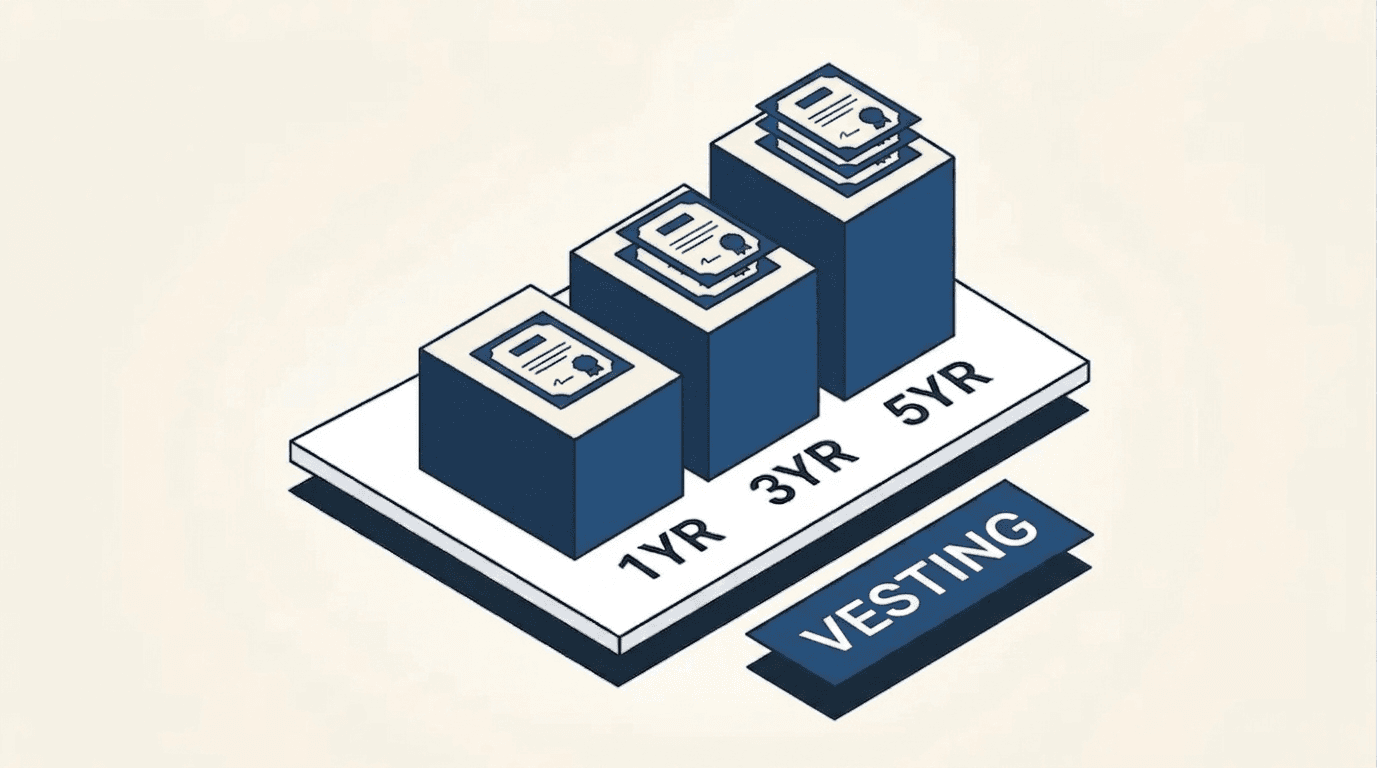
Vesting Schedules Explained: Cliffs, Timing, and the Tax at Vest
Vesting turns a promised grant into owned equity on a schedule. RSUs are taxed as ordinary income the day each tranche vests, sold or not.

A vesting schedule is the timeline that turns a promised equity grant into shares or options you own outright, tranche by tranche. Until a portion vests, it is a line on a grant letter. The moment it vests, RSUs create a tax bill: the IRS taxes the full value as ordinary income that day, whether you sell a share or not.
What Vesting Means for Your Equity
A grant letter promises you equity. A is what turns that promise into something you own, on a set calendar. Companies attach one to nearly every form of equity comp: RSUs, ISOs, NSOs, even some private-company profits interests. The schedule answers one question for each slice of your grant: on what date does this become mine?
Before a tranche vests, you have nothing you can sell, borrow against, or claim if you leave. After it vests, the shares, or for options the right to buy shares, belong to you. That line between vested and unvested decides your tax bill, what you keep if you're let go, and how much of your grant is locked in versus still hypothetical.
The Shapes a Vesting Schedule Can Take
Most companies build from the same base: four years total, with variation in how often shares release inside that window and how heavily the years are weighted.
A works like a new job's probationary period. You accrue tenure the whole time, but none of it counts on paper until you clear the date. Leave one day early and you walk away with nothing to show for the eleven months and twenty-nine days behind you.
One-year cliff: Nothing vests for the first twelve months. On day 366, or the exact cliff date named in your grant, roughly a quarter of the total award vests at once. Resign a week before your anniversary and that entire first-year chunk disappears.
Monthly or quarterly vesting: Once the cliff clears, the remaining three years usually release in equal monthly or quarterly installments. A 4,000-share grant with a one-year cliff might vest 1,000 shares at month twelve, then roughly 83 shares a month for the following 36 months.
Back-loaded vesting: Some companies weight later years more heavily, vesting a smaller share in year one and a larger share in years three and four. This design rewards long tenure and shows up most often in retention grants issued to existing staff rather than new hires.
Milestone or liquidity-based vesting: Instead of a pure calendar, vesting ties to an event: a funding round, a revenue target, or the company going public. Shares sit unvested until the milestone happens, no matter how many years you've worked there. This shape appears most often in founder and early-employee grants.
RSUs: Ordinary Income the Moment They Vest
For RSUs, vesting is not only an ownership event. It's a tax event, and you don't get a vote on timing. On the date a tranche vests, the number of shares released multiplied by the stock's becomes , added to your W-2 next to your salary. There's no capital gains rate at this stage, regardless of how long the grant sat on the books before vesting. Your employer withholds at the flat rate, 22% for most employees, whether or not that matches your actual bracket. Our piece on how RSUs are taxed at vesting covers that withholding gap in full.
Consider Devin, a product manager who joins a fictional startup called Cedarwave with a grant of 4,800 RSUs on a standard four-year schedule and a one-year cliff. The first twelve months produce no vesting and no tax at all. On the cliff date, 1,200 shares vest at once. If Cedarwave stock trades at $15 a share that day, Devin picks up $18,000 of ordinary income, withheld like a bonus. From month thirteen forward, the remaining 3,600 shares vest in equal monthly installments of roughly 100 shares. Each vest is its own taxable event, priced at whatever the stock happens to be worth that day. A vest in a month when the stock trades at $20 produces more ordinary income than a vest at $12, even though the share count is identical. Devin never chooses when this income arrives. The calendar decides.
Options Are Different: Vesting Is Just the Starting Line
Vesting works differently for ISOs and NSOs. It tells you when you're allowed to buy, nothing more. A vested option doesn't put shares in your account and doesn't create a tax bill on its own. It's a right to purchase shares at your fixed , not a share you already hold. You still have to exercise, writing a check or arranging a cashless exercise, to convert that right into stock. Nothing happens automatically the way it does with RSUs.
This distinction opens up planning that RSU holders never get. An RSU holder has zero control over when income lands. An option holder chooses the year, sometimes the exact week, to exercise. A , exercising and selling in one move, taxes the spread as ordinary income with nothing else to track. Exercise and hold instead, and you start the clock on treatment, though holding ISOs also risks triggering the Alternative Minimum Tax on the spread between strike price and fair market value.
Free tool
See what an ISO exercise could cost you
If you're holding vested ISOs and weighing when to exercise, run your grant details through the AMT calculator before you decide.
Estimate your AMT exposure
Our guides to incentive stock options and non-qualified stock options walk through exercise mechanics and the tax differences between the two option types.
Single-Trigger vs Double-Trigger RSUs at Private Companies
Public-company RSUs vest on time alone: clear the schedule and the shares are yours, taxable that same day. Private companies usually add a second condition, because handing employees a pile of shares with no market to sell into creates a tax bill nobody can pay in cash. That structure is called double-trigger vesting.
Under a double-trigger design, a tranche needs two things before it counts as vested for tax purposes: the normal time-based schedule, and a liquidity event such as an IPO or acquisition. You can clear four years of monthly vesting at a private company and still owe nothing, because the second trigger hasn't happened yet. Single-trigger RSUs, by contrast, vest and become taxable on time alone even at a private company. That structure is rarer, precisely because it creates the cash problem double-trigger design exists to avoid. Our full breakdown of double-trigger RSUs covers how the mechanics play out around an actual IPO.
This is an estimate only. Consult a qualified tax or financial advisor for personalized advice.
What Happens to Unvested Equity When You Leave
Unvested equity typically disappears the day you leave, whether you resign, get laid off, or are terminated for cause. Vesting schedules exist specifically to keep you from walking out the door with a grant you haven't earned yet. Whatever vested before your last day is yours to keep, subject to a short exercise window for options. Whatever hadn't vested reverts to the company's option pool, with no reimbursement for the years you spent waiting on it.
This is why the math around a job change has to separate what's vested from what's promised. A recruiter's offer to "make you whole" on unvested equity is replacing value your old company would have clawed back, not adding a bonus on top of your package. It's also why a large chunk of freshly vested shares raises a separate question, , since a departure often lines up with the biggest vest of your career landing all at once. Our RSU guide covers how to think about that concentration once the shares are sitting in your account.
Common questions
You forfeit the entire first tranche. A one-year cliff means nothing vests until you complete twelve full months, so leaving on day 350 produces the same result as leaving on day one: zero shares from that grant.
No. Vesting only makes an option exercisable. The tax depends on what you do next: exercising and holding ISOs can trigger AMT on the spread, exercising NSOs creates ordinary income at exercise, and a same-day sale of either type is taxed as ordinary income with no separate capital gains step.
Without a liquidity event as the second trigger, an employee could owe ordinary income tax on stock with no public market to sell into and no cash to cover the bill. Tying the tax event to an IPO or acquisition means the tax bill arrives around the same time the shares become sellable.
Last updated: July 2026. This is an estimate only. Consult a qualified tax or financial advisor for personalized advice.
Consult with an expert
Every vest is a taxable event whether you sell or not. Get caught unprepared and the bill is already due.
No commitment. A clear read on your situation from a CFP® who plans equity compensation for a living.

Author
Mitchell Ludwig, CFP®Mitchell built his practice around one problem: helping tech professionals turn equity compensation into lasting wealth. A decade guiding engineers through ISO exercises, AMT exposure, and liquidity events — no generic advice, no handoffs.
This article is for educational purposes only and reflects rules in effect as of the date above. Tax figures are estimates. Consult a qualified tax or financial advisor for advice specific to your situation.
Get the next article in your inbox.
No fluff. Just equity strategy and tax clarity, when it matters.
Keep reading
Restricted stock units (RSU)
How RSUs are taxed at vesting and why default withholding leaves a gap.
Read the guideESPPEmployee stock purchase plan (ESPP)
Buy company stock at a ~15% discount, a return most eligible employees never claim.
Read the guideCalculatorAMT Safe-Exercise Calculator
Holding options too? See your AMT exposure before you exercise.
Read the guideImportant disclosures
Mitchell Ludwig is a CERTIFIED FINANCIAL PLANNER™ professional and a Registered Investment Adviser Representative of Carolina Wealth Partners. Securities are offered through United Planners Financial Services, Member FINRA/SIPC. Carolina Wealth Partners and The Equity Architect are separate entities. Jon Ludwig is a Series 65–registered Investment Adviser Representative and promoter.
All content on this page is for informational and educational purposes only and does not constitute personalized investment, tax, or legal advice. Examples, illustrations, and client archetypes are composite in nature and do not represent any specific client. All tools and calculators are estimates only. Consult a qualified tax advisor or CFP® professional before making any financial decisions.
All marketing content is reviewed and approved by United Planners compliance in accordance with SEC Marketing Rule (Rule 206(4)–1). Past performance is not indicative of future results.