
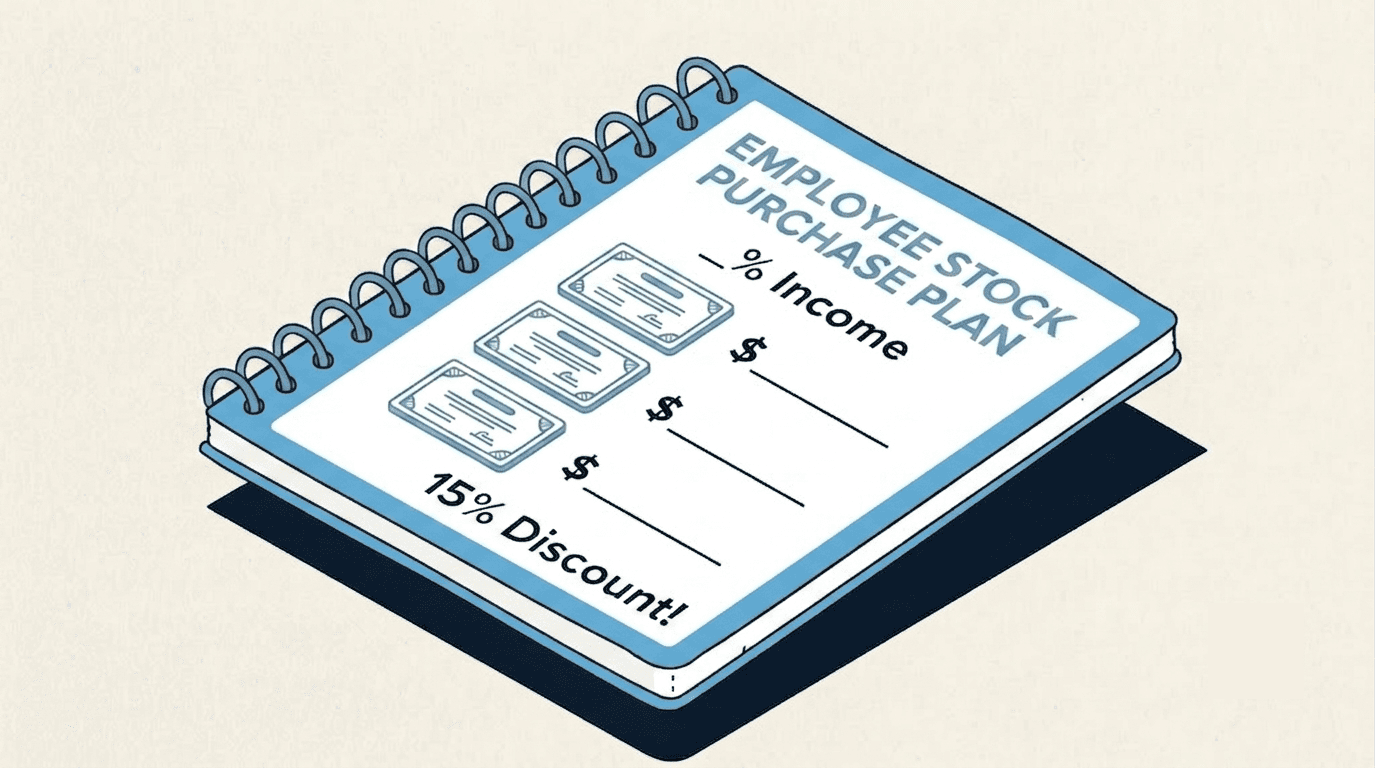
Employee stock purchase plan (ESPP)
Learn everything you need to know about employee stock purchase plans, including how the look-back provision works, ESPP tax treatment, and when to sell.

What is an ESPP?
An Employee Stock Purchase Plan (ESPP) lets you buy company stock through payroll deductions, typically at a 15% discount to the market price, up to an IRS limit of $25,000 in fair market value per calendar year. Contributions accumulate over an , often 6 to 24 months, before being used to purchase shares on a set purchase date.
A flat 15% discount alone is roughly a 17.6% pre-tax return before the stock price moves at all, yet only about 38% of eligible employees enroll, rising to just 48% even at companies offering the full 15% discount. Most of the employees who skip enrollment simply never had the mechanics explained to them.
For companies, ESPPs are a low-cost way to broaden employee ownership without the administrative overhead of a full option grant. For employees, the plan offers a built-in discount most people never fully claim, though the benefit only lands when you understand what you're being offered. It's also one of the most overlooked pieces of a tech employee's compensation, which is exactly the gap an equity compensation advisor like The Equity Architect is built to close.
Important terms to know:
: the window during which payroll contributions accumulate before purchase.
: the feature that prices your purchase off the lower of two dates.
: the discounted price you actually pay per share.
: a sale that meets the holding-period rules for favorable tax treatment.
: a sale made before those holding periods are met.
How the look-back provision works
Most plans price your purchase off the lower of the offering-start price or the purchase-date price: this is the . If the stock rises during the offering period, the discount is applied to the lower starting price, often producing a much larger effective gain than the stated 15% discount alone. Few employees know this feature exists, let alone model it before deciding how much to contribute.
A hypothetical example
Meet Alex, a hypothetical product manager contributing $6,000 during a 6-month offering period, enrolled in a 15%-discount ESPP with a look-back provision. The stock opens the offering period at $40.00/share and trades at $52.00/share on the purchase date.
Without the look-back, a flat 15% discount alone is roughly a 17.6% pre-tax return. The look-back provision (pricing the purchase off the lower of the offering-start or purchase-date price) is what turns Alex's return into 52%, because the stock rose during the offering period.
Hypothetical, illustrative example. Alex is not a real client and these figures do not represent any actual client or outcome. Figures assume a 15% discount with a standard look-back provision; actual plan terms vary by employer. This is an estimate only. Consult a qualified tax or financial advisor for personalized advice.
ESPP tax treatment
How much of your ESPP gain is taxed as ordinary income versus long-term capital gains depends entirely on how long you hold the shares after purchase.
Qualifying disposition
A requires holding ESPP shares at least 2 years from the offering date and at least 1 year from the purchase date. Part of the gain is then taxed at long-term capital gains rates rather than ordinary income rates, though a portion equal to the original discount is still typically taxed as ordinary income even in a qualifying disposition.
Disqualifying disposition
A , selling before those thresholds, taxes the discount portion as ordinary income in the year of sale, with any additional gain taxed as capital gains. This is the more common outcome, since most employees sell shares shortly after purchase.
The annual contribution limit
The IRC §423 limit caps ESPP purchases at $25,000 in fair market value per calendar year, measured as of the start of the offering period, not the discounted purchase price. Plans may also set a lower payroll-percentage cap on top of the IRS limit.
When to sell ESPP shares
Selling at purchase (a ) locks in the discount as a known return and avoids adding to your in employer stock, the same logic used for RSU sell-at-vest decisions. Holding toward a qualifying disposition can convert part of the gain to capital gains rates, but only if you're comfortable carrying the market risk of one additional stock position for the full holding period.
There is no universally correct answer. The right rule depends on how much employer stock you already hold across RSUs and options, your conviction in the company, and whether the tax savings from a qualifying disposition outweigh the risk of holding an illiquid, concentrated position for another year.
Common ESPP mistakes
- Not participating at all. Skipping enrollment forfeits a built-in discount few other benefits can match, and unlike a 401(k) match, there is no catch-up contribution for a period you sat out.
- Selling immediately without understanding the tax hit.A disqualifying disposition still owes ordinary income tax on the discount portion. Employees who don't plan for it are often surprised by extra W-2 income at tax time.
- Ignoring the $25,000 annual limit.Contributing without checking the IRC §423 cap can result in excess contributions that don't receive the intended tax treatment.
- Letting ESPP shares stack unmanaged. ESPP shares often pile on top of RSUs and options at the same employer, quietly building concentration risk that never gets reviewed alongside the rest of the equity position.
ESPP vs. other equity types
Restricted stock units (RSU) and incentive stock options (ISO) are the two other equity types most commonly paired with an ESPP at the same company. Each has a different tax trigger and a different lever for planning.
| ESPP | RSU | ISO | |
|---|---|---|---|
| Purchase / vest | You buy shares at a discount via payroll deduction | Shares are granted to you at no cost, taxed at vesting | You pay the strike price to exercise; may trigger AMT |
| Sell | Ordinary income on the discount, capital gains on the rest | Capital gains only on appreciation after vesting | Ordinary income or capital gains, depending on holding period |
Managing ESPP alongside RSUs and options
ESPP shares rarely exist in isolation. Most employees who participate also hold RSUs or ISOs at the same company. Treating the ESPP as a standalone payroll benefit, rather than folding it into the same concentration and diversification plan as your other equity, is how single-stock risk quietly builds up over time.
Common questions about ESPP taxation
- An Employee Stock Purchase Plan lets you buy company stock through payroll deductions, typically at a 15% discount to the market price, up to an IRS limit of $25,000 in fair market value per calendar year. A flat 15% discount is roughly a 17.6% pre-tax return before the stock price moves at all.
- A look-back provision bases your purchase price on the lower of the stock price at the start of the offering period or the price on the purchase date. If the stock rises during the offering period, the discount is applied to the lower starting price, often producing a much larger effective gain than the stated discount alone.
- A qualifying disposition requires holding ESPP shares at least 2 years from the offering date and at least 1 year from the purchase date; part of the gain is then taxed at long-term capital gains rates. A disqualifying disposition, selling before those thresholds, taxes the discount portion as ordinary income in the year of sale, with any additional gain taxed as capital gains.
- The IRC §423 limit caps ESPP purchases at $25,000 in fair market value per calendar year, measured as of the start of the offering period, not the discounted purchase price. Plans may also set a lower payroll-percentage cap on top of the IRS limit.
- Selling at purchase locks in the discount as a known return and avoids adding to your concentration in employer stock: the same logic used for RSU sell-at-vest decisions. Holding toward a qualifying disposition can convert part of the gain to capital gains rates, but only if you're comfortable carrying the market risk of one additional stock position for the full holding period.
ESPP discount and contribution rules per IRC §423 and IRS Publication 525. Participation figures per NASPP: Trends in ESPP Policies and Participation (2023 survey). This is an estimate only. Consult a qualified tax or financial advisor for personalized advice.

Author
Mitchell Ludwig, CFP®Mitchell built his practice around one problem: helping tech professionals turn equity compensation into lasting wealth. A decade guiding engineers through ISO exercises, AMT exposure, and liquidity events — no generic advice, no handoffs.
Consult with an expert
The ESPP discount is a rare built-in edge. Hold too long and concentration risk can erase it.
Go over your equity, your broader financial goals, and see how the E.Q.U.I.T.Y. System™ can build a plan around them.
Book an Equity Strategy CallMore on Employee Stock Purchase Plans

Important disclosures
Mitchell Ludwig is a CERTIFIED FINANCIAL PLANNER™ professional and a Registered Investment Adviser Representative of Carolina Wealth Partners. Securities are offered through United Planners Financial Services, Member FINRA/SIPC. Carolina Wealth Partners and The Equity Architect are separate entities. Jon Ludwig is a Series 65–registered Investment Adviser Representative and promoter.
All content on this page is for informational and educational purposes only and does not constitute personalized investment, tax, or legal advice. Examples, illustrations, and client archetypes are composite in nature and do not represent any specific client. All tools and calculators are estimates only. Consult a qualified tax advisor or CFP® professional before making any financial decisions.
All marketing content is reviewed and approved by United Planners compliance in accordance with SEC Marketing Rule (Rule 206(4)–1). Past performance is not indicative of future results.