

Pre-IPO Planning: The Moves That Expire After Liquidity
A handful of equity moves only work before your company goes public: early exercise with an 83(b) election, starting the QSBS clock, gifting shares at a low 409(a) valuation, and AMT-aware exercise timing. Here is the deadline for each.

Four planning moves only exist before your company's stock trades publicly: early exercise with an , starting the clock on real shares, gifting stock at a low , and timing ISO exercises around . Each has a hard deadline tied to your grant date, your termination date, or your company's next valuation reset, not to the IPO date itself.
The pre-liquidity window
The pre-liquidity window is the stretch between your grant date and the day your company either goes public or gets acquired, and most of the moves in this article close well before that day arrives. Founders and early employees assume they have until the IPO to act. An early-bird ticket works the same way: the discount holds until the doors open, then anyone still in line pays full price no matter how close they were to buying it minutes earlier. In practice, the 409(a) valuation your company uses to price options rises with every funding round, every revenue milestone, and every rumor of a public offering. A move that costs you a few hundred dollars in tax today can cost tens of thousands once the valuation triples.
The four moves below share a common thread: each depends on doing something while your shares (or your right to buy them) are still cheap, illiquid, and invisible to the tax code. Once your company files an S-1, sets a lockup period, or gets acquired, the underlying facts change and the option disappears with them.
Early exercise and the 83(b) election
An early exercise is the purchase of unvested stock, typically ISOs or NSOs, before the has run its course, and it only makes sense paired with a timely . Filing the 83(b) tells the IRS to tax the , the gap between your at purchase and your exercise price, in the year you buy rather than the year each tranche vests. If your company's 409(a) valuation is a few cents or a few dollars a share, that bargain element can be close to zero.
The filing deadline is 30 days from the date you exercise. There are no extensions and no exceptions for a missed mailing date. Miss the window, and the IRS taxes every future vesting tranche as ordinary income at whatever fair market value applies on that date, which for a company approaching an IPO could be many multiples of what you paid.
Early exercise requires your plan to allow it. Not every option grant permits early exercise. Check your plan document or ask your equity administrator before assuming this move is available.
The 83(b) clock starts at exercise, not at grant. You can early exercise years after your grant date and still file a valid 83(b), as long as you file within 30 days of the purchase itself.
Watch the $100,000 ISO limit. If the grant-date value of ISOs first becoming exercisable in a calendar year exceeds $100,000, the excess is treated as an NSO for tax purposes, which changes your withholding and AMT exposure.
Termination shortens your runway too. Most ISOs convert to NSOs if not exercised within 90 days of leaving the company, and they expire entirely 10 years from grant regardless of when you leave.
Renee, an early engineer at Solvira Energy, a pre-IPO grid-storage startup, held an ISO grant with a $0.40 exercise price when the company's 409(a) valuation sat at $0.55 a share. She early exercised 20,000 shares for $8,000 and filed her 83(b) within the 30-day window, paying tax on a $3,000 bargain element. Eighteen months later, after a Series C round, the 409(a) valuation reached $9.10 a share. Had she waited to exercise at vesting under that new valuation, her bargain element on the same 20,000 shares would have been roughly $174,000 instead of $3,000.
Starting the QSBS clock
The holding-period clock starts on the day you own qualifying stock outright, which for most equity comp holders means the day you exercise. This is the detail that trips people up: an unexercised option is not QSBS. If you wait until your company announces an IPO date to exercise, you may lock in a large tax bill on the exercise itself and still walk away with a holding period of zero.
Section 1202 QSBS treatment splits into two regimes depending on when you acquired the stock. Shares acquired on or before July 4, 2025 follow the legacy rule: a full 5-year hold produces a 100% exclusion, all or nothing, capped at the greater of $10 million or 10 times basis, and the issuing company had to meet a $50 million gross-assets test at issuance. Shares acquired after July 4, 2025 follow the OBBBA tiered rule instead: a 3-year hold produces a 50% exclusion, 4 years produces 75%, and 5 years produces the full 100%, with a higher $15 million cap (indexed for inflation after 2026) and a $75 million gross-assets test. Either regime taxes the non-excluded portion of gain at a 28% QSBS rate. California does not conform to any of this and taxes the full gain regardless of hold period.
This is an estimate only. Consult a qualified tax or financial advisor for personalized advice.
Renee's early exercise in 2023 started her QSBS clock under the legacy regime, since her shares were acquired before the July 2025 cutoff. If Solvira is acquired or goes public after she clears five years of ownership, and the company still qualifies as a small business under the gross-assets test, she can exclude the greater of $10 million or 10 times her basis from federal tax entirely. A colleague who waits to exercise a comparable grant in 2026 falls under the tiered regime instead: a 3-year hold already captures half the exclusion, though reaching the full 100% still takes five years. Either way, the clock runs only while you hold shares outright; unexercised options do not count. Investors weighing whether to hold or roll gains into a new qualifying company should also know about the Section 1045 rollover, which lets you defer gain by reinvesting in another qualifying small-business stock within 60 days, provided you held the original shares at least six months. For a full walk-through of the two regimes and how the caps interact, see our QSBS exclusion breakdown.
Gifting shares at a low 409(a) valuation
When you gift stock while the is low, you move future appreciation out of your estate at a fraction of its eventual public value. If you transfer shares to a spouse, a trust, or a family member while the company is still private, the value reported for gift-tax purposes is the current 409(a) figure, not whatever the stock trades for after the IPO. Everything the shares gain after the transfer belongs to the recipient's tax picture, not yours.
This move requires coordination with an estate attorney, since annual exclusion amounts, lifetime exemption limits, and the mechanics of transferring restricted stock (your company may need to approve the transfer, and vesting restrictions typically follow the shares) vary by situation and by year. These figures change often enough that you should confirm current limits with a qualified advisor before you act. The timing constraint does not vary: once your company sets an IPO date, transfers usually freeze under a lockup or blackout period, and the valuation you would be gifting against has already moved.
AMT-aware exercise timing
When you exercise ISOs while your company is private, you create a tax preference item for purposes equal to the bargain element, even though no sale has happened to generate cash for the tax. You determine whether you stay under the AMT exemption or fall into the steepest part of the phaseout by timing that exercise across tax years and against your other income.
For 2026, the AMT exemption is $140,200 for joint filers and $90,100 for single filers. The exemption phases out at 50 cents per dollar of alternative minimum taxable income above $1,000,000 (joint) or $500,000 (single), a range that produces an effective marginal rate near 42% on income inside the phaseout band. Above the exemption, AMT applies at 26% up to $244,500 of AMTI and 28% above that threshold. Any AMT you pay becomes a minimum tax credit that carries forward indefinitely and returns to you in a future year when your regular tax exceeds your tentative minimum tax, but that credit can sit unused for years if your income stays elevated.
Spread a large ISO exercise across two or three calendar years rather than doing it all at once, and run the numbers before December, not after. A single large exercise in one year can push you deep into phaseout territory even if the same total income, split across two years, would have kept you clear of it in each one.
Free tool
What's your AMT number?
Model your bargain element, exemption phaseout, and estimated AMT liability before you exercise, not after.
Run the AMT calculator
Our AMT calculator walks through the exemption and phaseout math using your actual grant numbers, and our piece on the ISO exercise decision goes deeper on how to weigh exercise timing against your broader financial picture.
The time-sequenced checklist
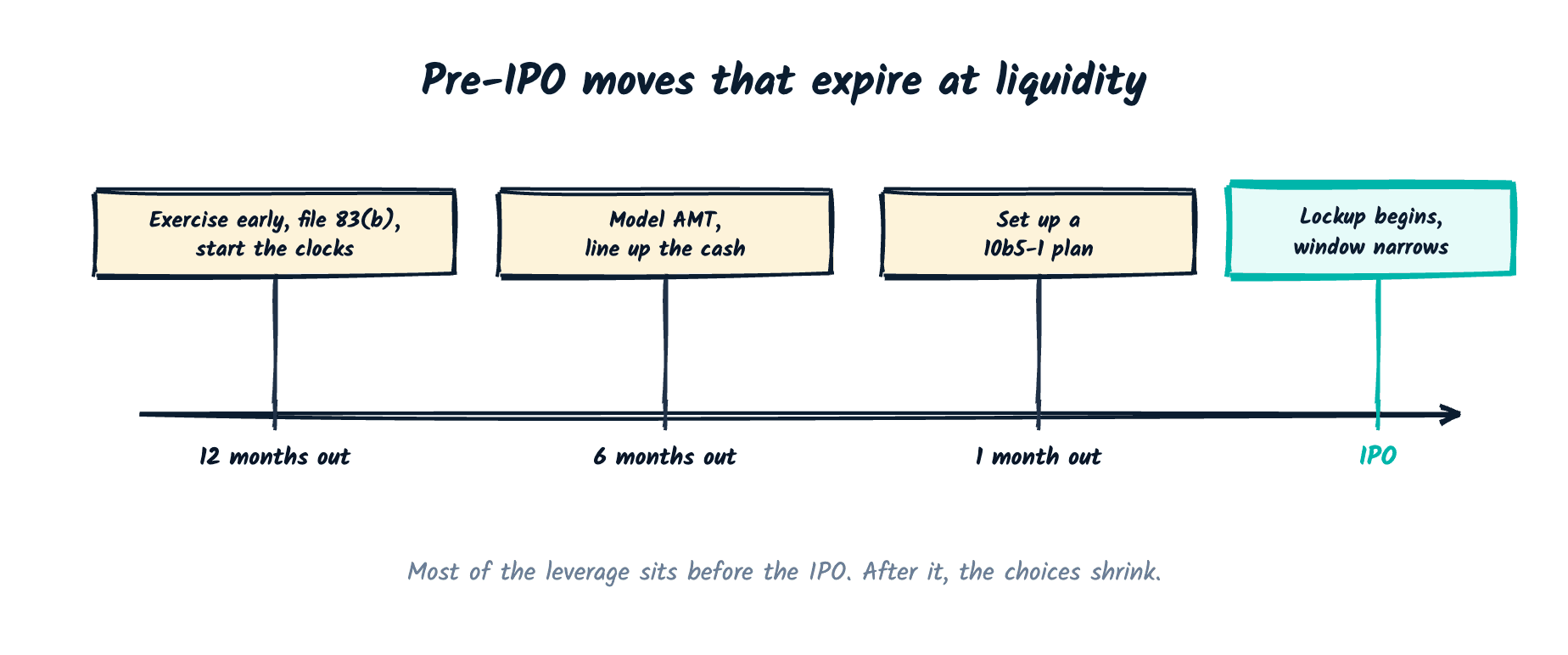
Each move has its own deadline, and several run in parallel rather than in sequence. The table below orders them by when each needs to happen relative to grant, vesting, and a rumored liquidity event.
| Timing | Move | Why it disappears at liquidity |
|---|---|---|
| Within 30 days of exercise | File the 83(b) election | Deadline is fixed by statute; no extensions exist regardless of your company's IPO timeline |
| As early as your plan allows | Early exercise unvested shares | Bargain element grows with every 409(a) reset your company undergoes |
| The day you exercise | Start the QSBS clock | The clock requires owned stock, not options; waiting until IPO rumors surface can mean starting from zero |
| Before the next 409(a) reset | Gift or transfer shares to family or a trust | Gift-tax value locks in at the current 409(a) figure; transfers typically freeze under lockup once an IPO date is set |
| Ongoing, before each exercise | Model AMT exposure and stage exercises across tax years | Unexercised options carry no AMT preference item; once you exercise, the preference item is locked in and cannot be reversed |
| Within 90 days of leaving the company | Exercise or forfeit ISOs | The runs on your termination date, independent of when or whether the company ever goes public |
Once your company announces a liquidity event, most of these rows close simultaneously. Blackout periods restrict trading and often transfers, double-trigger vesting can push a large batch of previously time-vested shares into ordinary income in a single tax year, and any unexercised options you were sitting on no longer have a low 409(a) valuation to exercise against. For the mechanics of how that single-year income spike works, our article on double-trigger RSUs covers the vesting cascade in detail. Anyone holding a mix of ISOs, early-exercise rights, and pre-IPO stock should treat the entire QSBS and equity planning pillar as required reading well before people inside the company start discussing a liquidity event.
Common questions
Yes, but only if you are exercising unvested shares for the first time within the last 30 days, since the deadline runs from your exercise date, not your company's timeline. An IPO announcement does not extend or shorten the 30-day window. It does raise the 409(a) valuation you would be exercising against, which usually makes early exercise far less attractive by the time the announcement happens.
Generally no, as long as the exchange qualifies as a tax-free reorganization under the tax code and you continue to hold stock in the same or a successor qualifying small business. Structural changes around an IPO, such as converting preferred shares or exchanging pre-IPO stock for public shares, can raise technical questions specific to your situation. Confirm the details with a tax professional before assuming your holding period carries over.
Your 90-day post-termination exercise window for ISOs runs regardless of whether a liquidity event has happened, so unexercised vested ISOs convert to NSOs or expire if you do not act within that window. Shares you already own from an early exercise keep accruing toward your QSBS holding period whether you are still employed or not, since QSBS eligibility depends on stock ownership, not continued employment.
Last updated: July 2026. This is an estimate only. Consult a qualified tax or financial advisor for personalized advice.
Consult with an expert
Four planning moves close the day your company files to go public. After that they're off the table.
No commitment. A clear read on your situation from a CFP® who plans equity compensation for a living.

Author
Mitchell Ludwig, CFP®Mitchell built his practice around one problem: helping tech professionals turn equity compensation into lasting wealth. A decade guiding engineers through ISO exercises, AMT exposure, and liquidity events — no generic advice, no handoffs.
This article is for educational purposes only and reflects rules in effect as of the date above. Tax figures are estimates. Consult a qualified tax or financial advisor for advice specific to your situation.
Get the next article in your inbox.
No fluff. Just equity strategy and tax clarity, when it matters.
Keep reading
Incentive stock options (ISO)
Start with how ISOs are taxed and where AMT comes from.
Read the guideRSURestricted stock units (RSU)
How RSUs are taxed at vesting and the withholding gap to plan around.
Read the guideCalculatorAMT Safe-Exercise Calculator
Run the numbers on an ISO exercise before year-end.
Read the guideImportant disclosures
Mitchell Ludwig is a CERTIFIED FINANCIAL PLANNER™ professional and a Registered Investment Adviser Representative of Carolina Wealth Partners. Securities are offered through United Planners Financial Services, Member FINRA/SIPC. Carolina Wealth Partners and The Equity Architect are separate entities. Jon Ludwig is a Series 65–registered Investment Adviser Representative and promoter.
All content on this page is for informational and educational purposes only and does not constitute personalized investment, tax, or legal advice. Examples, illustrations, and client archetypes are composite in nature and do not represent any specific client. All tools and calculators are estimates only. Consult a qualified tax advisor or CFP® professional before making any financial decisions.
All marketing content is reviewed and approved by United Planners compliance in accordance with SEC Marketing Rule (Rule 206(4)–1). Past performance is not indicative of future results.