
83(b) Elections: The 30-Day Filing That Can Save Six Figures
An 83(b) election taxes restricted stock or early-exercised options at today's low value instead of at each vesting date, starting the capital gains and QSBS clocks early. The filing deadline is 30 days from exercise, with no extensions.

An is a one-page notice filed with the IRS within 30 days of receiving restricted stock or early-exercising stock options. It locks in ordinary income tax on the bargain element at today's value instead of at each future vesting date, so later appreciation qualifies for treatment and the QSBS clock starts immediately. Miss the window and the option is gone for good.
What an 83(b) election does
File an 83(b) election and you choose to pay tax now, at the moment you receive or exercise restricted property, instead of later as it vests. Restricted stock and early-exercised options both fall under Section 83 of the tax code, which taxes property received for services at vesting, not at receipt. Without the election, the IRS treats each vesting tranche as a separate taxable event, measuring the spread between what you paid and the on that vesting date.
Filing the election flips that sequence. You pay tax once, upfront, on the spread that exists on the day you exercise or receive the grant. Every dollar of appreciation after that point falls outside the ordinary income system. Hold the shares long enough and the gain becomes long-term capital gains, taxed at a lower rate than wages. For founders and early employees at companies with real growth ahead, that swap is often worth thousands of dollars per vesting tranche.
Early exercise creates the opportunity
Most employees never encounter an 83(b) decision because standard stock options do not become taxable property until they vest and get exercised. The election only matters when a plan allows early exercise: buying unvested options before their completes. Early-exercise plans, common at seed and Series A companies, let you pay the exercise price on the full grant right away. The company keeps a right to buy back any unvested shares at your original price if you leave, and the shares you hold are restricted stock subject to the same 83(b) clock as a straight restricted stock grant.
Early exercise works best when a company grants options soon after founding, while the 409(a) valuation and exercise price sit low. A staff engineer who joins two years before a Series C round, when the common stock price has already climbed, gets far less benefit from early exercise because the up-front tax bill scales with that higher spread. Anyone comparing a full exercise now against waiting for later vesting should read our guide on the ISO exercise decision alongside this one, since the same early-versus-late tradeoff governs both.
The math: paying tax on today's spread
The bargain element is the gap between the you pay and the fair market value of the stock on the day you exercise. File an 83(b) election, and you owe tax on that gap now, for the entire grant, including shares that have not vested yet. Skip it, and the IRS instead measures the gap on each vesting date, applied only to the shares vesting that day.
A founding engineer exercises 40,000 shares at a $0.10 purchase price the same week they join, when the 409(a) valuation also sits at $0.10 a share. The table below shows what changes:
| Without 83(b) election | With 83(b) election | |
|---|---|---|
| Taxable spread at exercise | $0 (paid immediately, no election needed yet) | $0 (409a and purchase price match) |
| Taxable event | Recognized at each vesting date, on the FMV at that date | Recognized once, at exercise |
| FMV at year 2 vesting (example) | $4.00/share, spread taxed as ordinary income | Already taxed, no further ordinary income |
| Gain from $4 to eventual sale price | Ordinary income each vesting date | Long-term capital gains, if held over a year from exercise |
When exercise price and 409(a) value are identical, filing costs nothing today because the taxable spread is zero. The entire benefit shows up later, when the company's value rises and every dollar of gain above the exercise price becomes capital gains instead of wages. This is why founders and very early hires almost always file, while someone exercising after several priced rounds faces a real, sometimes large, tax bill the day they file.
Free tool
Not sure what your number looks like?
Run your exercise numbers through the calculator to see the ordinary income, AMT exposure, and cash needed before you file.
Try the AMT Calculator
If the exercise price and current FMV have already diverged by the time you can early-exercise, filing an 83(b) means writing a real check to the IRS for income you have not sold anything to fund. For ISOs exercised early, that spread also counts as an AMT preference item, which is why running the numbers before you file matters.
This is an estimate only. Consult a qualified tax or financial advisor for personalized advice.
When an 83(b) election helps most
The spread at exercise is small or zero. Early hires at pre-Series-A companies exercise the same week the 409(a) valuation matches the exercise price, so the election costs nothing today and shifts all future gains to capital treatment.
You can fund the purchase price without strain. Early exercise means paying for shares you do not yet own outright. Filing only makes sense if the cash outlay does not crowd out other financial priorities.
You plan to hold for the long-term capital gains clock. The clock for long-term capital gains starts at exercise, not at vesting. Selling before that clock runs erases the benefit of filing at all.
The stock could qualify for QSBS treatment. Section 1202 reaches full exclusion at a five-year hold, whether the shares fall under the legacy all-or-nothing rule or the newer tiered schedule that phases exclusion in starting at three years. Filing an 83(b) at exercise starts that clock years ahead of waiting for shares to vest on their own schedule.
You believe the company will grow. The entire trade rests on appreciation. Without it, you have paid tax and cash for nothing in return.
Derek, a founding engineer at Solace Grid, a pre-IPO battery-storage startup, joins at the seed stage and early-exercises his full four-year grant of 48,000 shares at a $0.05 exercise price, matching that week's 409(a) valuation. He files his 83(b) election on day 12 after exercise, well inside the 30-day window, and owes no tax because the spread is zero. Three years later, Solace Grid raises a Series C at a share price of $18. Because Derek's grant date and exercise date line up with his 83(b) filing, the IRS will tax every dollar of that $18 gain as long-term capital gains from his $0.05 basis, not as ordinary income at vesting, whenever he sells. If Solace Grid also meets the QSBS gross-assets test at issuance, Derek's five-year clock toward a full exclusion under Section 1202 started on his exercise date instead of a later vesting anniversary.
Derek's bet works like paying property tax on a vacant lot before construction starts, instead of waiting until the finished house next door sells for ten times the land price. The tax bill locks in at the lot price no matter how much value the construction adds later.
If the stock fails, the money is gone
An 83(b) election is irreversible. File it, pay the tax, and the company folds or the stock goes to zero before you vest: the cash you spent on the purchase price and the tax you already paid do not come back. If you leave the company before your unvested shares vest, the company can still buy back those shares at your original exercise price, and the IRS will not refund any tax you paid on the now-forfeited portion, despite what most employees expect.
This is the real risk calculation behind every 83(b) decision, and it has nothing to do with the tax code. It is a bet, funded with real cash, on a company that has no public market, no guaranteed liquidity event, and often only a few quarters of runway. An at a later-stage company is a paper loss you can walk away from by not exercising. Restricted stock you paid for and paid tax on carries a cash loss no matter what happens to the company.
Anyone weighing this decision on options that vest the standard way, without early exercise, should also read our piece on NSO exercise timing. The same cash-outlay-versus-appreciation tradeoff shows up there, minus the 30-day clock.
Filing mechanics: the 30-day window
The IRS gives no extensions and no exceptions on the 83(b) deadline. Day one is the date you exercise the option or the date restricted stock transfers to you, not your grant date and not the date you signed paperwork with the company.
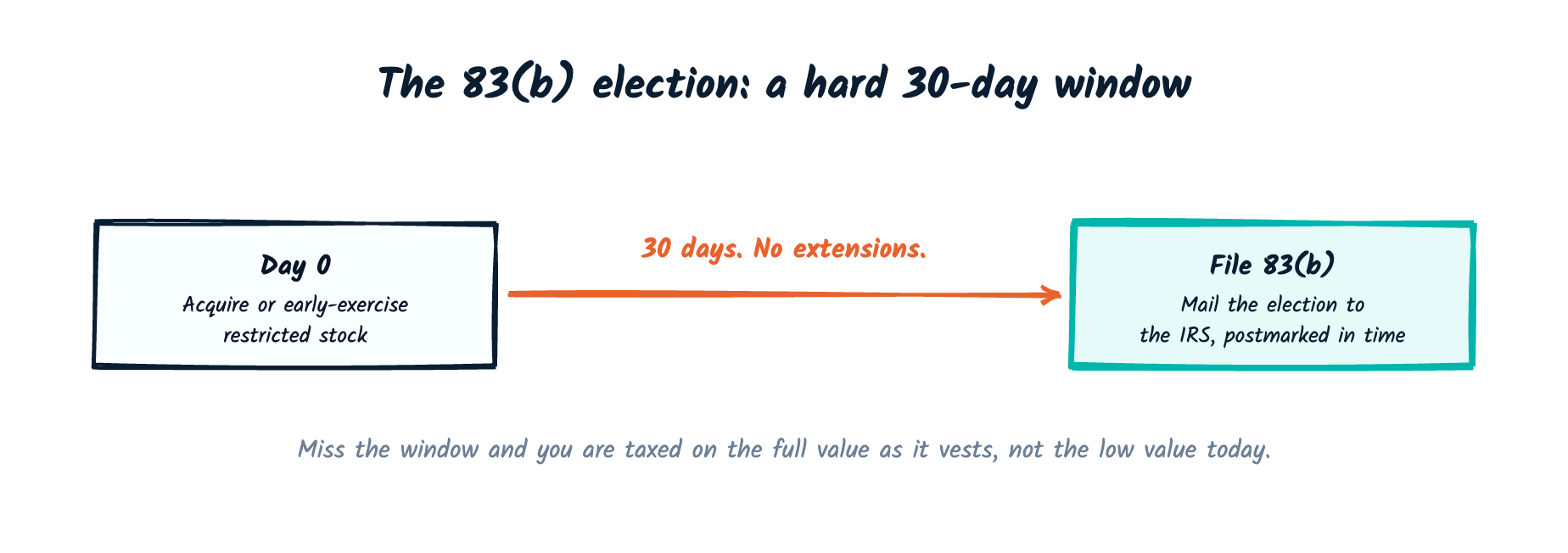
- Exercise the options or accept the restricted stock grant, and record the exact transfer date. That date starts the clock, counted in calendar days, weekends included.
- Draft the election letter with the required elements: your name, address, and Social Security number; a description of the property; the date of transfer and the taxable year; the restrictions on the stock; the fair market value at transfer; the amount you paid; and a statement that you are electing under Section 83(b).
- Mail the signed original to the IRS Service Center where you file your federal return, using certified mail with a return receipt, postmarked within 30 days of the transfer date.
- Send a copy to your employer's stock plan administrator or HR team so the company's records match what you filed.
- Keep a copy for your own records and attach it to your federal tax return for the year of the transfer.
For founders working through an 83(b) election on a mix of ISOs and QSBS-eligible common stock, our ISO pillar guide covers how the election interacts with the $100,000 ISO limit and the AMT preference item in more depth. And since the holding-period math only pays off if the shares eventually qualify, review the specific gross-assets and hold-period rules in our QSBS exclusion breakdown before you count on that outcome.
Common questions
Yes, if the ISO plan allows early exercise before the option vests. The election applies to the restricted stock you receive upon early exercise, not to the option itself. Filing starts your holding-period clocks early and can reduce the AMT preference item that would otherwise appear at each future vesting date, since the spread is measured once, at the low early-exercise value, rather than repeatedly as the stock appreciates.
The IRS enforces the 30-day window with no extensions and no late-filing relief, so the election is gone once the window closes. Every future vesting date becomes a separate ordinary income event instead, taxed on the spread between your exercise price and the fair market value on that date.
Yes. For stock eligible under Section 1202, the five-year holding period for legacy QSBS, or the tiered three, four, and five-year schedule for stock acquired after July 4, 2025, both begin on the date you acquire the shares through exercise, not on the date each tranche vests. Filing an 83(b) election at an early exercise date can move that clock years ahead of waiting for full vesting.
Last updated: July 2026. This is an estimate only. Consult a qualified tax or financial advisor for personalized advice.
Consult with an expert
The 83(b) window is 30 days with no extensions. Miss it and the election is gone for good.
No commitment. A clear read on your situation from a CFP® who plans equity compensation for a living.

Author
Mitchell Ludwig, CFP®Mitchell built his practice around one problem: helping tech professionals turn equity compensation into lasting wealth. A decade guiding engineers through ISO exercises, AMT exposure, and liquidity events — no generic advice, no handoffs.
This article is for educational purposes only and reflects rules in effect as of the date above. Tax figures are estimates. Consult a qualified tax or financial advisor for advice specific to your situation.
Get the next article in your inbox.
No fluff. Just equity strategy and tax clarity, when it matters.
Keep reading
Incentive stock options (ISO)
How ISOs are taxed, the AMT trap at exercise, and the qualifying-disposition holding periods.
Read the guideCalculatorAMT Safe-Exercise Calculator
Estimate what an ISO exercise could cost you in AMT this year, before you pull the trigger.
Read the guideNSONon-qualified stock options (NSO)
NSOs are taxed as ordinary income at exercise. Timing across tax years is the main lever.
Read the guideImportant disclosures
Mitchell Ludwig is a CERTIFIED FINANCIAL PLANNER™ professional and a Registered Investment Adviser Representative of Carolina Wealth Partners. Securities are offered through United Planners Financial Services, Member FINRA/SIPC. Carolina Wealth Partners and The Equity Architect are separate entities. Jon Ludwig is a Series 65–registered Investment Adviser Representative and promoter.
All content on this page is for informational and educational purposes only and does not constitute personalized investment, tax, or legal advice. Examples, illustrations, and client archetypes are composite in nature and do not represent any specific client. All tools and calculators are estimates only. Consult a qualified tax advisor or CFP® professional before making any financial decisions.
All marketing content is reviewed and approved by United Planners compliance in accordance with SEC Marketing Rule (Rule 206(4)–1). Past performance is not indicative of future results.