
NSO Exercise Timing: Splitting a Big Exercise Across Two Tax Years
Exercising nonqualified stock options creates ordinary income on the spread the day you exercise. Splitting a large exercise across December and January can keep that income out of a higher bracket.

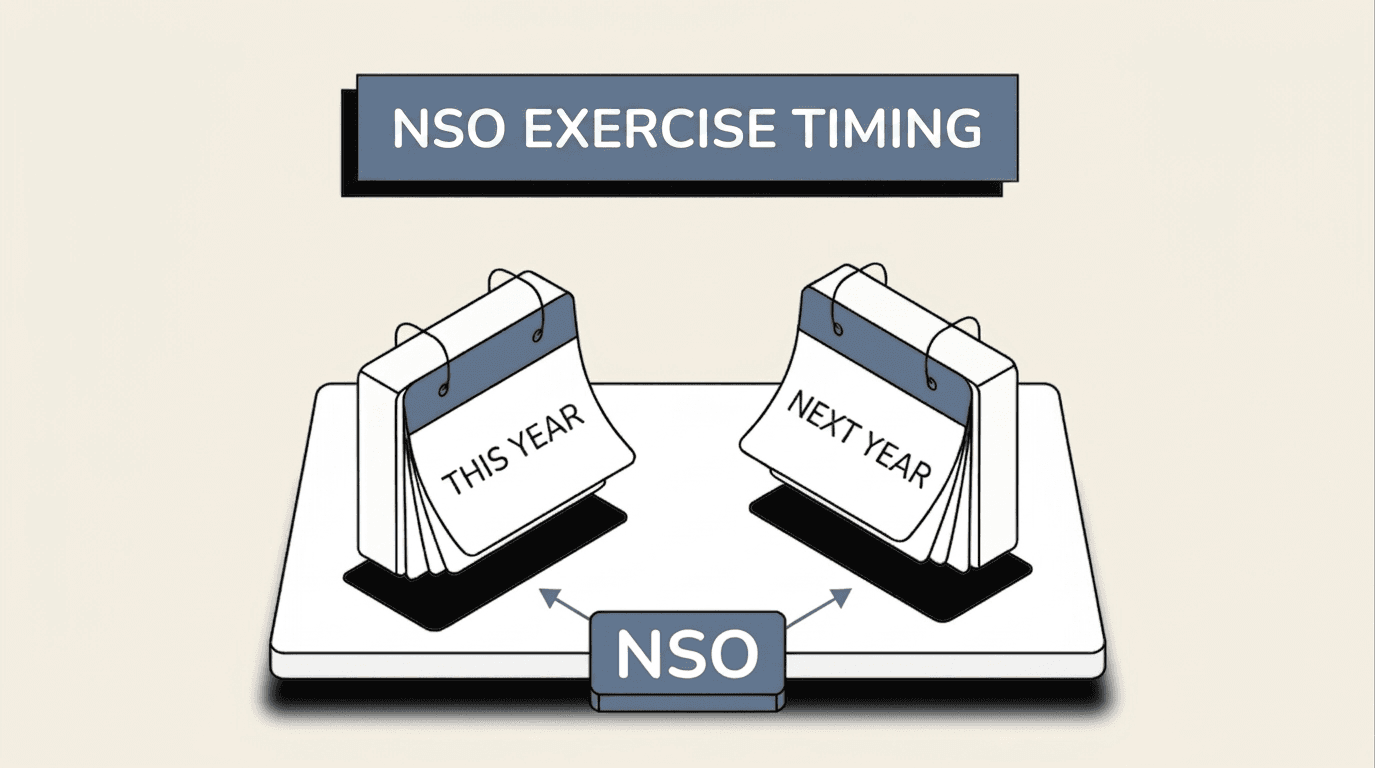
Exercising a nonqualified stock option triggers ordinary income tax on the difference between what you pay and what the shares are worth that day, all in the year you exercise. If a large exercise would push you into a higher bracket or the phaseout, splitting the shares across a December exercise and a January exercise spreads that income across two tax years instead of stacking it into one.
NSO Basics
A nonqualified stock option, or NSO, gives you the right to buy company stock at a fixed set on the , and it doesn't get the preferential tax treatment that incentive stock options can qualify for. Employers grant NSOs to employees, contractors, advisors, and board members alike, because unlike ISOs, there's no $100,000 annual limit and no requirement that the recipient be an employee.
The mechanics look similar to an ISO on the surface. You have a , an exercise price, and a window after you leave the company to exercise vested shares before they expire. The tax treatment is where NSOs diverge from ISOs. Every dollar of gain at exercise is ordinary income, reported on your W-2 if you're an employee, subject to payroll withholding, and taxed at your marginal rate that year. There's no capital gains rate available on the spread, no AMT preference item, and no holding-period game to play before exercise.
Companies use NSOs for a straightforward reason: they're simpler to administer and carry no statutory eligibility restrictions. If you're comparing option types before deciding when to exercise, the NSO pillar page covers grant structure and post-termination rules in more depth.
The Spread: What Gets Taxed at Exercise
The spread is the gap between the stock's fair market value on the day you exercise and the price you pay, and it's taxed as ordinary income the moment you exercise, regardless of whether you sell the shares. A private company's comes from its most recent ; a public company's comes from the closing price that day.
Say your exercise price is $8 per share and the current FMV is $50. Exercising 10,000 shares creates a $420,000 spread ($42 times 10,000), and that entire amount lands on your W-2 as ordinary income for the year you exercised, on top of your salary and bonus. You owe federal income tax on it at your marginal rate, state income tax where applicable, and payroll taxes (Social Security up to the wage base, Medicare, and the additional 0.9% Medicare surtax above certain income thresholds).
This is an estimate only. Consult a qualified tax or financial advisor for personalized advice.
Compare that to an ISO exercise, where the spread can avoid ordinary income tax if you hold long enough and stay under the AMT threshold. NSOs don't offer that path. The spread is ordinary income every time, which is why timing a large exercise matters.
The Withholding Gap
Your employer withholds federal tax on the NSO spread using the flat rate: 22% up to $1 million of supplemental income in the year, 37% above that. That flat rate falls short of your final liability whenever your marginal bracket sits at 32%, 35%, or 37%, and the 22% withholding leaves a gap you'll need to cover with estimated payments or at filing.
Take the $420,000 spread from the earlier example. At 22% withholding, your employer sends $92,400 to the IRS. If that spread pushes your total income into the 35% bracket, your liability on that spread alone could run closer to $147,000. The $54,600 difference doesn't show up until you file. If you haven't set aside cash or made estimated payments, it arrives as an unpleasant surprise plus a possible underpayment penalty.
Withholding sets a floor, not your bill. The 22% (or 37% above $1M) supplemental rate is a payroll mechanic. Your marginal bracket determines the real number you owe at filing.
State withholding often lags too. Many states apply their own flat supplemental rate, which can also undershoot your marginal state rate if you're a high earner.
Payroll taxes stack on top. Medicare and the additional 0.9% surtax apply to the spread as wage income, separate from your income tax withholding.
Estimated payments close the gap. If you know withholding will fall short, a fourth-quarter estimated payment avoids an underpayment penalty at filing.
The Two-Year Split: Why December/January Matters
Splitting a large NSO exercise into two pieces, one in December and one in January, spreads the ordinary income across two separate tax years instead of concentrating it in one, which can keep more of the spread inside a lower bracket in each year. Because the spread counts as income in the calendar year you exercise, exercising half your shares on December 20 and the other half on January 5 puts roughly half the income in year one and half in year two.
The benefit isn't automatic. It depends on your income shape in both years. If your salary and other income are similar year to year, splitting the exercise keeps each year's total income lower, which can mean less of the spread gets taxed at your top marginal rate and less exposure to the AMT phaseout if you're also managing ISO exercises or other ordinary income items. If you expect a much higher income year (a bonus, a liquidity event, a job change with a signing bonus), splitting into that higher year can backfire, since you'd be adding NSO income to an already-elevated bracket.
A few factors to check before splitting:
- Current-year bracket room. Check how much more ordinary income you can absorb this year before crossing into the next bracket.
- Next-year income forecast. Confirm whether next year's income is expected to rise, fall, or stay flat. A known raise, bonus, or liquidity event changes the math.
- Stock price trend. Splitting across two dates means two different FMVs. If the 409A valuation or public price is rising, waiting for January means a bigger spread on that half.
- Expiration and blackout constraints. Check whether a or a company blackout period forces your hand before you'd otherwise choose to exercise.
- AMT interaction. If you're also exercising ISOs in the same window, run both years through the numbers separately. NSO income doesn't create an AMT preference item, but it does add to the income that determines whether you land in the AMT phaseout band from other sources.
Worked Example: Priya's December/January Split
Priya is a staff engineer at Vantia Robotics, a pre-IPO defense-tech company. She holds 20,000 vested NSOs at an $8 exercise price, and the current 409A valuation puts FMV at $46 per share, a $38 spread per share. Her base salary is $210,000, and she's single. Once this year's NSO spread stacks on top of that salary, her combined income lands well into the 35% marginal federal bracket, a threshold her preparer will need to confirm against that year's actual tax tables.
If Priya exercises all 20,000 options in December, she creates a $760,000 spread in one tax year. Combined with her $210,000 salary, her total income for the year approaches $970,000, with a meaningful share of the spread landing in her top marginal bracket. Her employer withholds 22% on the first $1 million of supplemental income for the year, which falls well short of her actual marginal rate on income at that level. She'd need a sizable fourth-quarter estimated payment to avoid a penalty, and she and her preparer would need to confirm where each bracket threshold falls that year.
Instead, Priya splits the exercise: 10,000 shares on December 22, 10,000 shares on January 6. Each exercise creates a $380,000 spread (assuming FMV holds steady across the two weeks). In year one, her total income is $210,000 salary plus $380,000 spread, about $590,000. In year two, assuming her salary again runs $210,000, the second $380,000 spread again lands on a $590,000 total rather than stacking onto an already-elevated $970,000 year. Spreading the exercise this way keeps each year's income lower than the single-year alternative, which reduces the portion of the spread exposed to her top marginal rate, and it gives her two separate windows to size estimated payments to each year's actual liability.
The plain analogy: exercising a large NSO block in one shot is like pouring a full bucket of water into a glass that's already three-quarters full. Some of it overflows at the highest rate available. Splitting the pour across two glasses (two tax years) means less of it spills over the top in either one.
Decision Checklist Before You Split
Model both years, not just one. Project total taxable income for the current year and the next before committing to a split date.
Confirm the exercise window allows it. A December/January split only works if your post-termination exercise window or company blackout schedule permits exercising in both periods.
Check concentration exposure. Exercising creates a large private or newly public stock position. Review concentration risk from a single stock holding before deciding how many shares to exercise at all.
Line up cash for taxes and the purchase price. You need cash for the exercise price itself plus enough set aside to cover the gap between withholding and your actual liability.
Coordinate with any ISO exercises. If you also hold ISOs, decide the order of exercises together. NSO and ISO income interact differently with the AMT, and sequencing both in the same planning conversation avoids surprises.
Common questions
No. The AMT preference item applies to ISO spreads held past year-end, not NSO spreads. NSO income is ordinary income reported on your W-2, taxed under the regular system. It can still affect your total income for the year, which matters if you're also exercising ISOs and tracking exposure to the AMT phaseout from combined income sources.
Yes, but only the appreciation after exercise qualifies for capital gains treatment. The spread at exercise is always ordinary income no matter how long you hold afterward. If the stock rises further and you sell more than a year after exercise, that additional gain qualifies for long-term capital gains rates; the original spread never does.
Vested NSOs usually must be exercised within a set after you leave, commonly 90 days, though some companies extend this. Unvested shares are typically forfeited. Confirm your specific window in your grant agreement or option plan document before making any resignation or timing decisions.
Last updated: July 2026. This is an estimate only. Consult a qualified tax or financial advisor for personalized advice.
Consult with an expert
Exercise all at once and bracket stacking takes a bigger cut. The timing window closes at year-end.
No commitment. A clear read on your situation from a CFP® who plans equity compensation for a living.

Author
Mitchell Ludwig, CFP®Mitchell built his practice around one problem: helping tech professionals turn equity compensation into lasting wealth. A decade guiding engineers through ISO exercises, AMT exposure, and liquidity events — no generic advice, no handoffs.
This article is for educational purposes only and reflects rules in effect as of the date above. Tax figures are estimates. Consult a qualified tax or financial advisor for advice specific to your situation.
Get the next article in your inbox.
No fluff. Just equity strategy and tax clarity, when it matters.
Keep reading
Non-qualified stock options (NSO)
How NSOs are taxed as ordinary income at exercise, and why exercise timing is the main lever.
Read the guideISOIncentive stock options (ISO)
The ISO cousin: no ordinary income at exercise, but an AMT preference and holding-period rules.
Read the guideCalculatorAMT Safe-Exercise Calculator
Holding ISOs too? Estimate the AMT before you exercise.
Read the guideImportant disclosures
Mitchell Ludwig is a CERTIFIED FINANCIAL PLANNER™ professional and a Registered Investment Adviser Representative of Carolina Wealth Partners. Securities are offered through United Planners Financial Services, Member FINRA/SIPC. Carolina Wealth Partners and The Equity Architect are separate entities. Jon Ludwig is a Series 65–registered Investment Adviser Representative and promoter.
All content on this page is for informational and educational purposes only and does not constitute personalized investment, tax, or legal advice. Examples, illustrations, and client archetypes are composite in nature and do not represent any specific client. All tools and calculators are estimates only. Consult a qualified tax advisor or CFP® professional before making any financial decisions.
All marketing content is reviewed and approved by United Planners compliance in accordance with SEC Marketing Rule (Rule 206(4)–1). Past performance is not indicative of future results.