
How the 2026 AMT Rules Changed: Why More ISO Holders Will Owe It
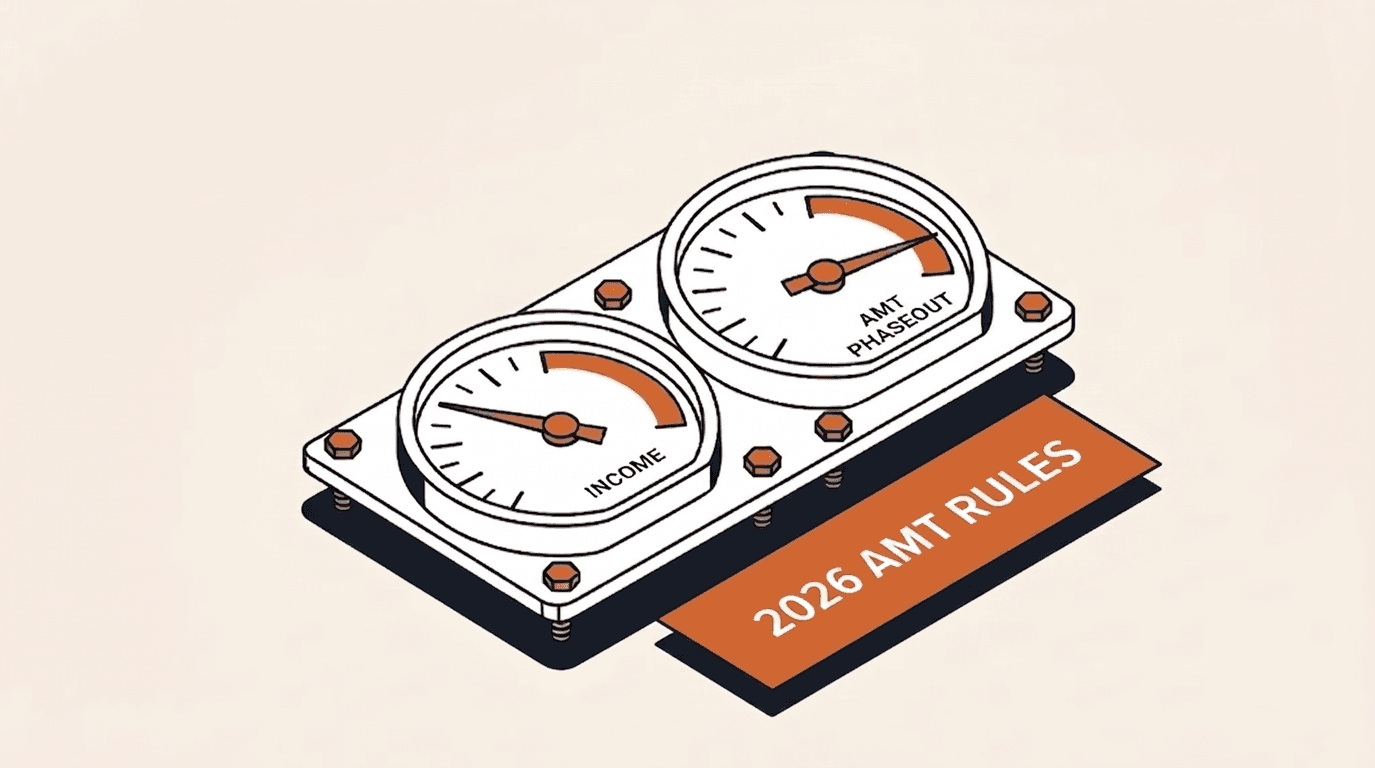
The One Big Beautiful Bill Act reset the AMT phaseout for 2026. The exemption held, but it now phases out sooner and twice as fast, pushing more ISO exercises into AMT. Here are the numbers and what to do before December 31.

If you exercise in 2026, the Alternative Minimum Tax math is not the same as it was in 2025. The One Big Beautiful Bill Act (OBBBA, enacted as H.R.1) kept the larger AMT exemption but reset how fast that exemption disappears at higher incomes. It now phases out sooner, and at twice the speed. The same ISO exercise that stayed clear of AMT last year can trigger it this year.
This article covers what moved, the exact 2026 figures, and the timing decisions that matter before December 31.
What changed for 2026
The AMT is a parallel tax calculation. You run your taxes the normal way, run them again under AMT rules, and pay whichever is higher. When you exercise ISOs and hold the shares, the (the gap between the and your ) is invisible to regular tax but counts as income under AMT. That single line is why ISO holders meet the AMT.
OBBBA left the exemption amounts at their higher post-2017 levels, which helps. It changed the phaseout instead: the income level where the exemption starts shrinking, and the speed at which it shrinks. Both moved against high earners for 2026.
The three numbers that moved
For a married couple filing jointly in 2026:
AMT exemption: $140,200 ($90,100 single). This amount was made permanent and did not drop. The first slice of AMT income is still shielded.
Phaseout threshold: $1,000,000 ($500,000 single). Above this level of AMT income, the exemption begins to disappear. This reverted to the 2018 starting point, far lower than the roughly $1.25M threshold of recent years.
Phaseout rate: 50 cents per dollar. For every dollar of AMT income above the threshold, you lose 50 cents of exemption, double the previous 25-cent rate.
The AMT rates themselves are unchanged: 26% on AMT income up to $244,500, and 28% above it.
Free tool
See what an ISO exercise costs you under the 2026 rules
Enter your grant details and get a personalized estimate of the AMT a 2026 exercise could trigger, plus the largest exercise that stays clear of it.
Calculate your 2026 AMT exposure
The 42% band inside the phaseout
When you are inside the phaseout range, each extra dollar of AMT income is taxed at the 28% rate and also removes 50 cents of your exemption, which exposes another 50 cents to tax. Together those push the effective marginal rate near 42%, higher than the headline 28% AMT rate and higher than several ordinary brackets.
This matters most for ISO holders. An exercise that pushes your AMT income into the phaseout band is taxed more than the rate table suggests. The band starts at $1,000,000 of AMT income for joint filers, and a large exercise can put you inside it.
This is an estimate only. Consult a qualified tax or financial advisor for personalized advice.
A worked example
Meet Priya, a staff software engineer at Vantia Robotics, a pre-IPO defense-tech company. She holds 10,000 vested ISOs with a $2 and a $22 fair market value. She wants to exercise and hold to start her long-term capital gains and QSBS clocks, so her bargain element is $200,000. Regular tax ignores that $200,000. AMT does not.
Added to her AMT income and taxed at the 26% to 28% AMT rates, that $200,000 slice carries roughly $52,000 to $56,000 of tentative minimum tax. She owes it as AMT to the extent it tops her regular tax on the same income, and since regular tax never counted the spread, most of it becomes a real bill in April.
Now give Priya a partner who also earns well, so the couple already sits at $1,000,000 of AMT income before she exercises. The same $200,000 spread now lands entirely inside the 42% band. The exercise that would have cost her about $52,000 in a lower-income year costs closer to $84,000 once the phaseout claws back the exemption. Same grant, same strike, a different bill driven only by the income she exercised into.
Here is the mental model. AMT is a second tax bill calculated beside your regular one, and you pay whichever comes out higher. For most of the year your regular bill wins. Exercise a large block of ISOs and the AMT bill can jump ahead, so the spread you never "received" in cash still sets what you owe.
Who this hits hardest
Three groups feel the 2026 change most:
Pre-IPO employees at high-valuation companies. A rising widens the bargain element on every share. The larger the spread, the faster an exercise clears the phaseout threshold.
Dual-income households near $1,000,000. Two strong tech salaries can put a couple close to the phaseout floor before a single ISO is exercised. The exercise then lands entirely in the 42% band.
Anyone who modeled an exercise on 2025 numbers. The old $1.25M phaseout start and 25-cent claw-back produced a different answer. A plan built last fall can owe five figures more this year.
Why more ISO holders will owe AMT this year
Three forces compound in 2026. The phaseout threshold dropped, so high earners reach it sooner. The phaseout rate doubled, so the exemption disappears faster once they do. And valuations at many pre-IPO firms have climbed, widening the bargain element on every share exercised.
The practical result: exercises that fit under the AMT line in prior years now cross it. If you are planning an or an exercise-and-hold to start your and clocks, run the 2026 numbers before you commit. You may owe AMT on the same plan that was clear last year.
What to do before December 31
AMT is calculated on the calendar year, which makes timing your strongest lever. A few moves worth pricing out now:
- Find your crossover. The most useful figure is the largest number of shares you can exercise before AMT begins. Everything up to that point costs you nothing extra; everything past it falls into the 42% band.
- Split an exercise across two years. Exercising part of your grant in December and part in January spreads the bargain element across two AMT calculations instead of stacking it into one. Splitting a $200,000 spread into two $100,000 exercises can keep each year under the phaseout threshold and preserve the full exemption both times.
- Mind the phaseout edge. If a planned exercise lands you inside the $1,000,000 band, trimming it to stay below the threshold can save more than the shares are worth in near-term tax.
- Model the credit. AMT you pay is not always lost (see below), but the timing of recovery affects whether accelerating or delaying makes sense.
How the AMT credit comes back
The AMT you pay is not a penalty. It becomes a minimum tax credit that carries forward with no expiration. In any later year where your regular tax exceeds your tentative minimum tax, the credit releases the difference back to you.
The catch is timing. The credit only returns in years your regular tax runs higher than your AMT, which for many exercisers means after they sell the shares or after a spike in income normalizes. Exercise and hold for years and the cash you paid in AMT sits as a credit the whole time. Plan the exercise around when you expect to recover it, not only the year you trigger it.
For a large exercise the recovery can stretch across several years, because the credit releases a slice at a time. That timing is the real cost of AMT on a long hold, and it is why the size and the year of an exercise matter as much as whether it crosses the AMT line at all.
What did not change
A few things held steady, and they matter:
The bargain element is still the trigger. Only the spread on an exercise-and-hold counts. A (exercising and selling in the same year) generates instead and sidesteps the AMT preference, at the cost of the capital gains treatment.
AMT does not disqualify QSBS. Paying AMT on an ISO exercise has no effect on your Qualified Small Business Stock eligibility. They run on independent rules.
The mechanics of AMT have not changed. OBBBA moved where the line sits, and in 2026 it sits closer than most ISO holders expect. If you are weighing an exercise, The ISO Exercise Decision: AMT vs. Cash-Flow walks through the full tradeoff, and our Incentive Stock Options guide covers the mechanics.
Common questions
No. The exemption was made permanent at its higher level: $140,200 for joint filers, $90,100 for single filers. What changed is the phaseout, which starts at a lower income ($1,000,000 joint) and removes the exemption twice as fast, at 50 cents per dollar.
Inside the phaseout band, each additional dollar is taxed at 28% and also costs you 50 cents of exemption, which exposes more income to tax. The combined effect pushes the marginal rate to roughly 42% until the exemption is fully phased out.
No. AMT only applies if your tentative minimum tax exceeds your regular tax. Small exercises often stay under the line. The point where they cross is your AMT crossover, and the AMT calculator finds it for your specific grant.
Last updated: July 2026. Reflects the AMT provisions of the One Big Beautiful Bill Act (H.R.1) and IRS Form 6251. This is an estimate only. Consult a qualified tax or financial advisor for personalized advice.
Consult with an expert
Three AMT numbers changed for 2026. The exercise that was safe last year may not be now.
No commitment. A clear read on your situation from a CFP® who plans equity compensation for a living.

Author
Mitchell Ludwig, CFP®Mitchell built his practice around one problem: helping tech professionals turn equity compensation into lasting wealth. A decade guiding engineers through ISO exercises, AMT exposure, and liquidity events — no generic advice, no handoffs.
This article is for educational purposes only and reflects rules in effect as of the date above. Tax figures are estimates. Consult a qualified tax or financial advisor for advice specific to your situation.
Get the next article in your inbox.
No fluff. Just equity strategy and tax clarity, when it matters.
Keep reading
AMT Safe-Exercise Calculator
Enter your grant details and see your estimated AMT exposure in seconds.
Read the guideISOIncentive stock options (ISO)
The equity type that triggers AMT. How ISOs work and how to plan the exercise.
Read the guideRSURestricted stock units (RSU)
RSUs are taxed as ordinary income at vesting, and the 22% default withholding rarely covers it.
Read the guideImportant disclosures
Mitchell Ludwig is a CERTIFIED FINANCIAL PLANNER™ professional and a Registered Investment Adviser Representative of Carolina Wealth Partners. Securities are offered through United Planners Financial Services, Member FINRA/SIPC. Carolina Wealth Partners and The Equity Architect are separate entities. Jon Ludwig is a Series 65–registered Investment Adviser Representative and promoter.
All content on this page is for informational and educational purposes only and does not constitute personalized investment, tax, or legal advice. Examples, illustrations, and client archetypes are composite in nature and do not represent any specific client. All tools and calculators are estimates only. Consult a qualified tax advisor or CFP® professional before making any financial decisions.
All marketing content is reviewed and approved by United Planners compliance in accordance with SEC Marketing Rule (Rule 206(4)–1). Past performance is not indicative of future results.