
Understanding AMT: What Every ISO Holder Needs to Know Before Exercising
The Alternative Minimum Tax can turn a smart ISO exercise into a costly mistake. Here's how it works and how to stay in the safe zone.

Reviewed by Mitchell Ludwig, CFP® · 2025-04-01
What Is the Alternative Minimum Tax?
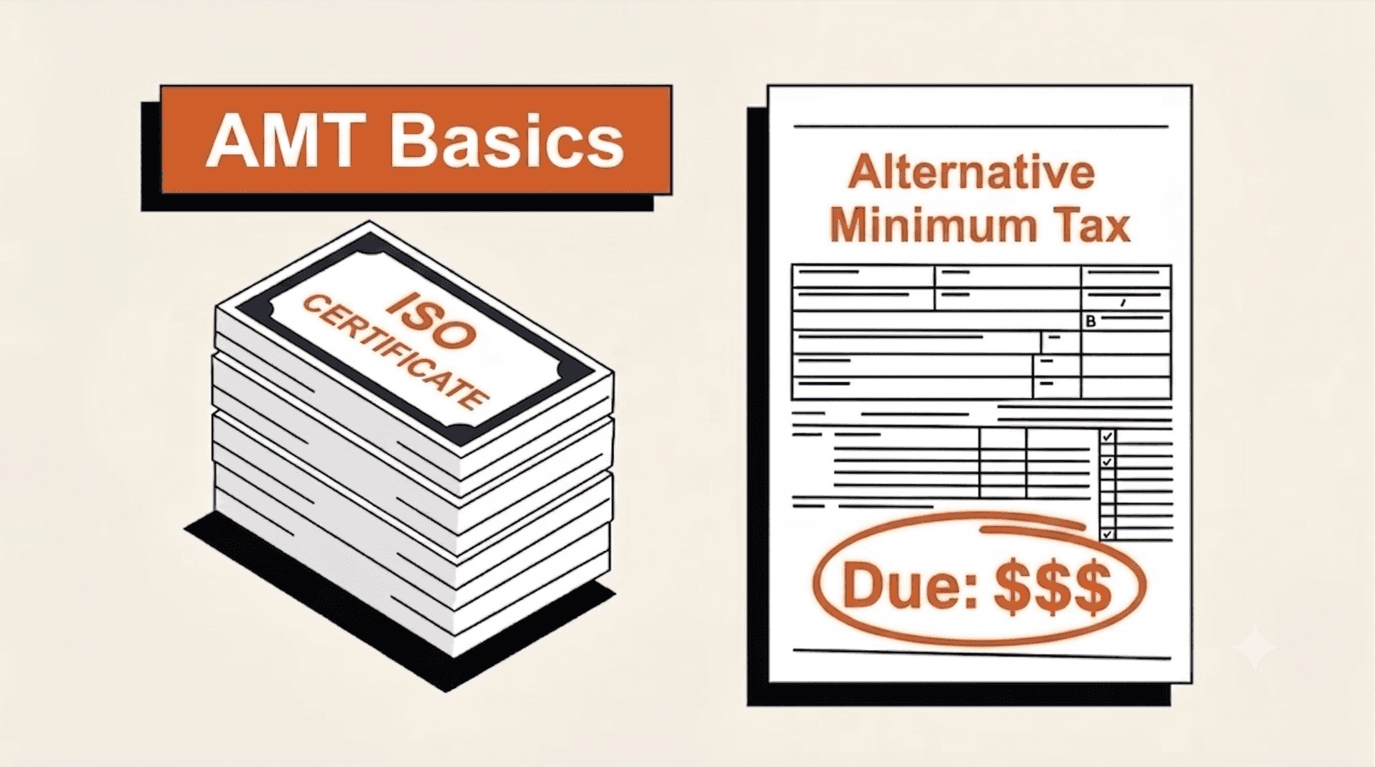
The Alternative Minimum Tax (AMT) is a parallel tax system designed to ensure high-income individuals pay a minimum level of federal tax regardless of deductions. For employees with Incentive Stock Options (ISOs), the AMT is one of the most important and most misunderstood tax rules they face.
How ISO Exercise Triggers AMT
When you exercise ISOs, you don't pay regular income tax on the "spread" (the difference between the fair market value and your strike price). AMT counts that spread as a "preference item" in your Alternative Minimum Taxable Income (AMTI).
This means:
- You calculate your regular income tax the usual way
- You add the ISO spread to your income for AMT purposes
- You apply the AMT exemption and AMT tax rates
- If your tentative minimum tax exceeds your regular tax, you pay the difference as AMT
The Safe Harbor Concept
The most valuable number for ISO holders is the safe harbor share count: the largest number of shares you can exercise in a year without triggering AMT.
You find it by locating the ISO spread where your tentative minimum tax equals your regular tax.
Use our AMT Calculator to find your exact safe harbor number.
The AMT Credit Carryforward
One piece of good news: any AMT you pay becomes a credit you can use in future years when your regular tax exceeds the AMT. You haven't lost the money. It's a timing difference.
This is an estimate only. Consult a qualified tax advisor or CFP® before making any ISO exercise decisions.
Consult with an expert
Exercise without running the AMT and you could owe tax on a paper gain you never cashed.
No commitment. A clear read on your situation from a CFP® who plans equity compensation for a living.

Author
Jon LudwigJon founded The Equity Architect as the resource he wished existed when he was first decoding his own equity package. He builds the tools, the research, and the writing that make equity math legible. He doesn’t manage money or give advice — that runs through Mitchell.
Reviewed for accuracy by Mitchell Ludwig, CFP® · 2025-04-01
This article is for educational purposes only and reflects rules in effect as of the date above. Tax figures are estimates. Consult a qualified tax or financial advisor for advice specific to your situation.
Get the next article in your inbox.
No fluff. Just equity strategy and tax clarity, when it matters.
Keep reading
AMT Safe-Exercise Calculator
Enter your grant details and see your estimated AMT exposure in seconds.
Read the guideISOIncentive stock options (ISO)
The equity type that triggers AMT. How ISOs work and how to plan the exercise.
Read the guideRSURestricted stock units (RSU)
RSUs are taxed as ordinary income at vesting, and the 22% default withholding rarely covers it.
Read the guideImportant disclosures
Mitchell Ludwig is a CERTIFIED FINANCIAL PLANNER™ professional and a Registered Investment Adviser Representative of Carolina Wealth Partners. Securities are offered through United Planners Financial Services, Member FINRA/SIPC. Carolina Wealth Partners and The Equity Architect are separate entities. Jon Ludwig is a Series 65–registered Investment Adviser Representative and promoter.
All content on this page is for informational and educational purposes only and does not constitute personalized investment, tax, or legal advice. Examples, illustrations, and client archetypes are composite in nature and do not represent any specific client. All tools and calculators are estimates only. Consult a qualified tax advisor or CFP® professional before making any financial decisions.
All marketing content is reviewed and approved by United Planners compliance in accordance with SEC Marketing Rule (Rule 206(4)–1). Past performance is not indicative of future results.