
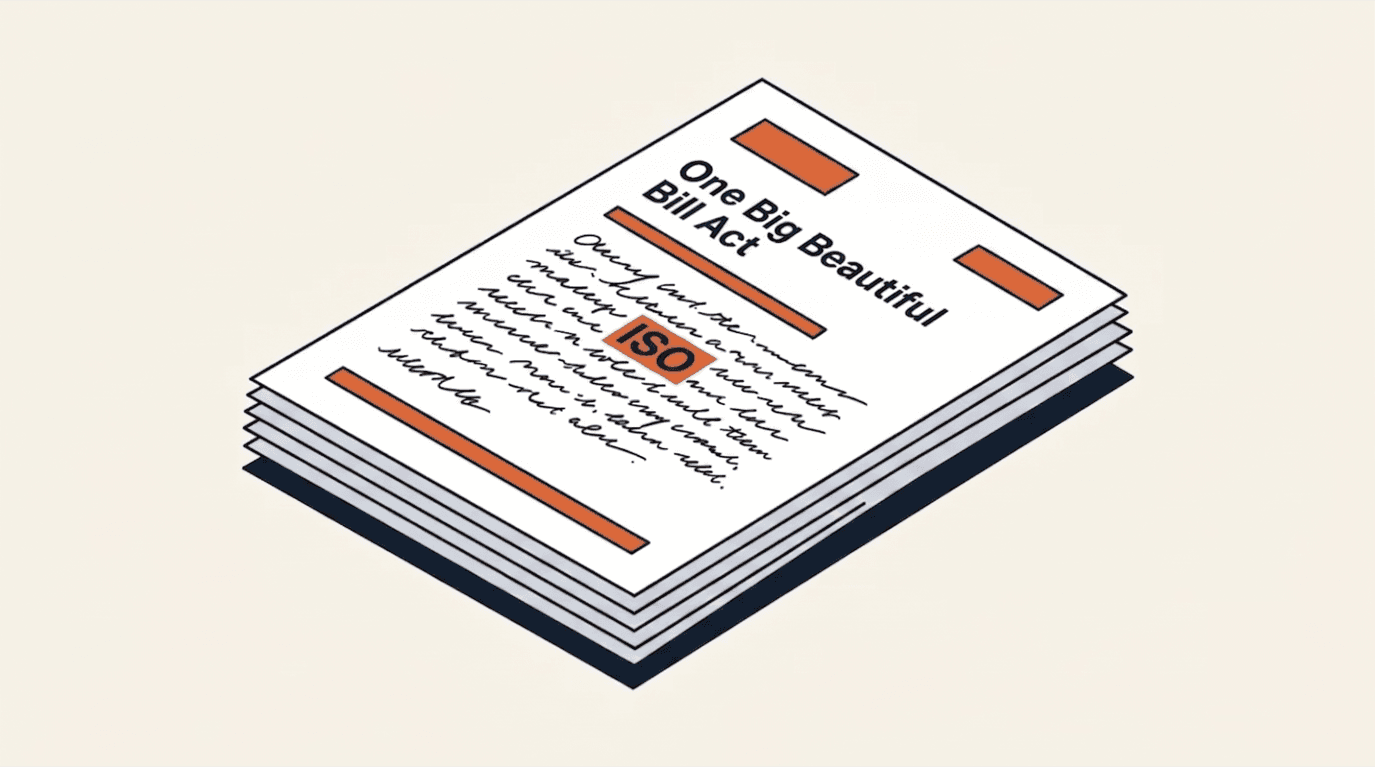
The 2026 OBBBA Rules Changed Your AMT Number
OBBBA changed how the AMT hits ISO exercises. If you're exercising before year-end, your safe number moved. See what changed and how to find yours.

Hold incentive stock options and planning to exercise before December 31? The number you can exercise without triggering a painful Alternative Minimum Tax bill has changed. The One Big Beautiful Bill Act (OBBBA) adjusted the AMT exemption and how fast that exemption phases out at higher incomes. That phaseout is where most ISO exercises go wrong. Below: what moved, why it matters more for equity holders than for most taxpayers, and how to find your new safe-exercise number before the year-end deadline.
What OBBBA changed about the AMT
The Alternative Minimum Tax is a parallel tax system: you calculate your tax the normal way, calculate it again under AMT rules, and pay whichever is higher. Two levers decide how much AMT you owe: the exemption (income shielded before AMT applies) and the phaseout (the income level where that exemption starts disappearing).
OBBBA changed both. The headline is the exemption amount, but the phaseout side matters more for equity compensation. As your income climbs through the phaseout range, you lose exemption on top of paying tax on new income, so each additional dollar can be taxed at an effective rate well above the stated AMT rate.
The practical takeaway: the rules of thumb from a year or two ago no longer produce the right answer. A "how many shares can I exercise" number that was safe under the old exemption and phaseout may now push you into AMT, or in some cases leave more room than you expect.
Why this hits ISO holders specifically
For most taxpayers, AMT is a footnote. For ISO holders, it's the single biggest risk in the exercise decision.
When you exercise ISOs and hold the shares, you don't owe regular income tax on the spread, the gap between your strike price and the fair market value at exercise. That spread is counted as income under AMT. You can exercise, sell nothing, receive no cash, and still owe a five- or six-figure tax bill on paper gains you can't spend. Because OBBBA changed the thresholds that decide when and how hard AMT applies, it changed the size of the exercise that lands you there.
Free tool
See your AMT exposure before you exercise
Enter your grant details and get a personalized estimate of what an ISO exercise could cost you this year.
Calculate your AMT exposure
The phaseout zone is where the damage happens
Inside the exemption phaseout range, each dollar of AMT income does two things: it gets taxed, and it strips part of your remaining exemption. That combination pushes your marginal rate on those dollars well above the headline AMT rate.
For an ISO holder, the cost of "a few more shares" is not linear. Exercising the block that tips you into the phaseout zone can cost far more than the block before it. A personalized number beats a general rule here, because the math depends on your income, your filing status, and the size of your spread.
How to find your new safe-exercise number before year-end
Three moves, in order:
- Establish your baseline. Your safe-exercise capacity depends on your other income for the year: salary, RSU vesting, a spouse's income, capital gains. AMT counts the whole household picture, not the option grant in isolation.
- Model the exercise against the current thresholds. The calculator applies the exemption and phaseout figures now in effect and shows estimated AMT for a given share count, so you can find the point where the math turns against you.
- Leave room to act before December 31. The IRS assesses AMT on the calendar year. If you plan to spread an exercise across tax years to stay under the threshold, you have to decide and execute before year-end. There is no retroactive fix in January.
Avoiding AMT entirely isn't always the goal. Sometimes paying some AMT to start the long-term capital-gains and QSBS clocks is the right call. Make that trade on purpose, with your real number in front of you, instead of discovering it on a tax return in April.
Frequently asked questions
Did OBBBA make AMT better or worse for ISO holders? Both, depending on your income. Changes to the exemption and phaseout can help lower-income exercisers and hurt those in the phaseout band. To know your direction, model your situation against the current figures.
I exercised earlier this year under the old assumptions. What now? Your exercise is locked, but your remaining year-end planning isn't. If you were planning a second exercise or a disqualifying disposition before December 31, re-run the numbers under the current rules first.
Can I wait until next year? Sometimes. Spreading exercises across tax years is a core AMT-management strategy, but it interacts with your vesting schedule, any option expiration dates, and the ISO holding-period clocks. Waiting is a real lever, not a reflex.
Is the calculator's number final? No. It's an estimate built to show you the shape of your exposure and where the thresholds sit. Before you exercise a meaningful position, walk the result through with a CFP® professional who can see your whole return.
Consult with an expert
The law moved your safe-exercise number for 2026. Last year's plan can trigger AMT this year.
No commitment. A clear read on your situation from a CFP® who plans equity compensation for a living.

Author
Mitchell Ludwig, CFP®Mitchell built his practice around one problem: helping tech professionals turn equity compensation into lasting wealth. A decade guiding engineers through ISO exercises, AMT exposure, and liquidity events — no generic advice, no handoffs.
This article is for educational purposes only and reflects rules in effect as of the date above. Tax figures are estimates. Consult a qualified tax or financial advisor for advice specific to your situation.
Get the next article in your inbox.
No fluff. Just equity strategy and tax clarity, when it matters.
Keep reading
AMT Safe-Exercise Calculator
Enter your grant details and see your estimated AMT exposure in seconds.
Read the guideISOIncentive stock options (ISO)
The equity type that triggers AMT. How ISOs work and how to plan the exercise.
Read the guideRSURestricted stock units (RSU)
RSUs are taxed as ordinary income at vesting, and the 22% default withholding rarely covers it.
Read the guideImportant disclosures
Mitchell Ludwig is a CERTIFIED FINANCIAL PLANNER™ professional and a Registered Investment Adviser Representative of Carolina Wealth Partners. Securities are offered through United Planners Financial Services, Member FINRA/SIPC. Carolina Wealth Partners and The Equity Architect are separate entities. Jon Ludwig is a Series 65–registered Investment Adviser Representative and promoter.
All content on this page is for informational and educational purposes only and does not constitute personalized investment, tax, or legal advice. Examples, illustrations, and client archetypes are composite in nature and do not represent any specific client. All tools and calculators are estimates only. Consult a qualified tax advisor or CFP® professional before making any financial decisions.
All marketing content is reviewed and approved by United Planners compliance in accordance with SEC Marketing Rule (Rule 206(4)–1). Past performance is not indicative of future results.